Building a Coat of Arms: Heraldry as a Systems Diagram
I designed a coat of arms. It turned out to be less about tradition and more about how I think.
- heraldry
- personal
- design
I've been interested in Medieval history for a long time, and at some point that interest crossed paths with a question I found genuinely hard to answer: if you had to distill how you think and work into a single image, what would it look like?
Heraldry turns out to be a surprisingly good framework for that. It's a formal visual language with strict rules. Every element has a name, a placement, and a meaning. It rewards intentional design and punishes decoration for its own sake. That appealed to me. So I made one.
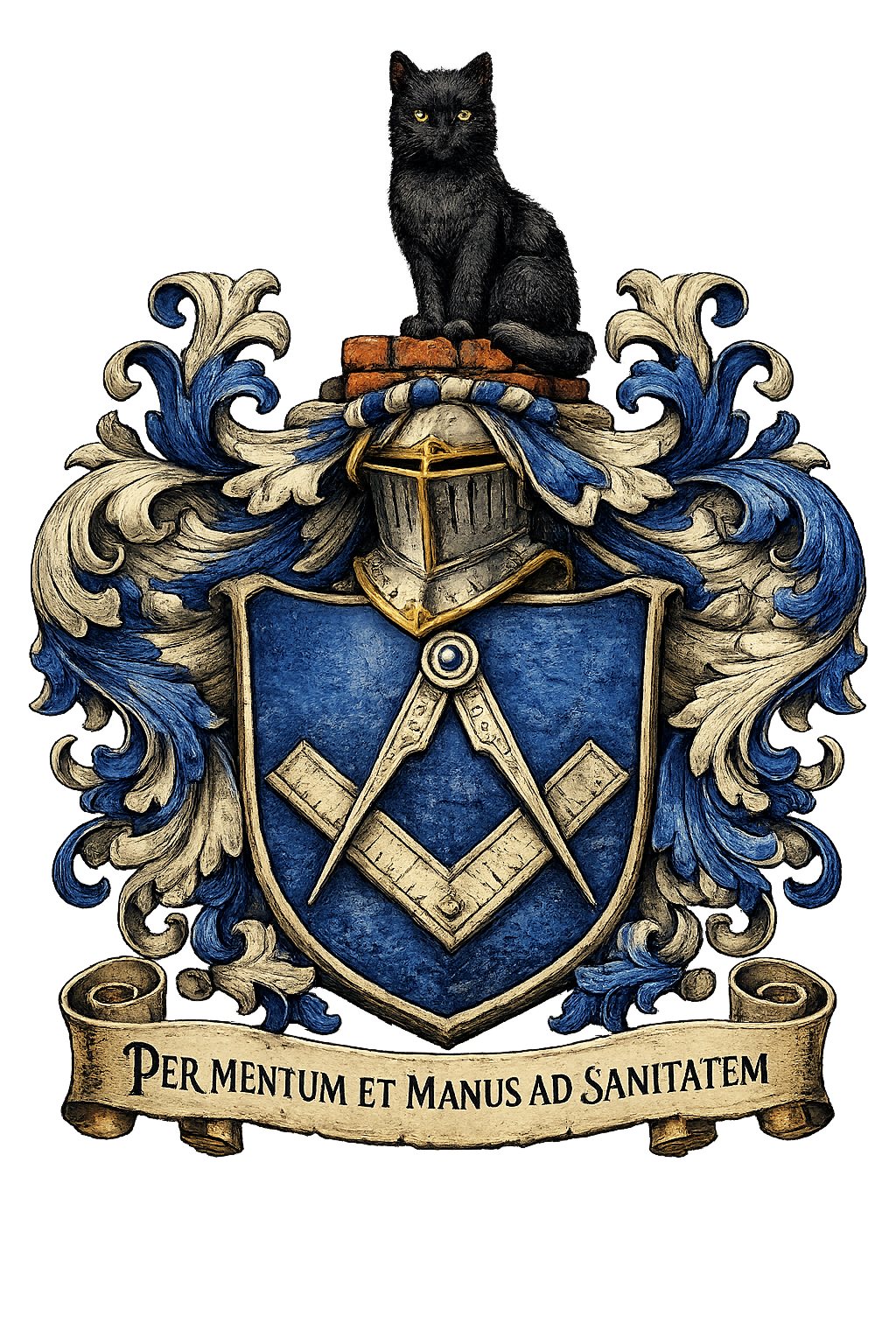
The Blazon
The formal heraldic description — called a blazon — is how a coat of arms is encoded in plain language, precisely enough that any trained herald could reconstruct it without ever seeing the image.
Mine reads:
Azure, a square and compass argent. Crest: a cat sejant sable, upon a brick proper. Helm: a tilting helm affronté, argent, visored and trimmed or. Mantling: azure doubled argent. Motto: Per mentum et manus ad sanitatem.
Every word in that sentence is load-bearing. Here's what it actually means.
The Field: Azure
The background of a shield is called the field, and blue — azure in heraldic terms — carries specific weight. It traditionally signals wisdom, stability, and structured thought. It's the color of someone who designs before they build.
I didn't pick it for aesthetics. I picked it because it accurately describes how I approach problems. Architecture before action. Understanding before execution.
The Charge: Square and Compass
The central image on the shield is the charge, and this one is doing most of the work.
The square and compass are ancient symbols of craft and geometry. Separately, they mean different things: the square represents grounding and correctness, the constraints of physical reality. The compass represents abstraction and possibility, the space of what could be designed.
Together, they describe a mode of thinking I recognize in myself: the tension between what is possible and what is appropriate. You don't just build what you can. You build what you should, in the way it should be built.
The compass sits centered on the shield, which in heraldic convention implies governance rather than subordination. The square anchors the base. Read literally: design shapes possibility, but execution is what matters.
The Helm
The helm on a coat of arms is not decorative. Its style and orientation encode specific meaning.
This one is a tilting helm, facing forward (affronté), which signals readiness and command. It's steel with gold trim: resilience in the body, earned authority in the detail. Not inherited rank. Demonstrated competence.
The simple read: I am responsible for what I build.
The Mantling
The flowing cloth around the helm is traditionally stylized from torn fabric, representing a helm that has actually been through something. Here it's rendered in blue and silver: strategic vision on the outside, execution and refinement on the inside.
It curls like waves under load, which felt accurate. Infrastructure under stress can still be elegant. That's the goal.
The Crest: A Black Cat Sejant on a Brick
This is the personal part.
The crest sits above the helm and is where most people put lions, eagles, or other symbols of force. I put a black cat sitting on a brick. That was deliberate.
The cat — sable, meaning black — represents independence, precision, and selective action. It is not a symbol of brute force or loyalty. A cat watches. It waits. When it acts, it acts with intention and accuracy. That's the kind of operator I try to be: not reactive, not aggressive, but precise. Choosing when to intervene rather than treating every situation as an emergency requiring maximum force.
The brick is the grounding element. It represents masonry, craft, and physical reality — the first unit of any structure. A single brick is a quiet statement: everything large is built from something small done correctly. The cat sitting atop it is instinct grounded in real work.
The Motto
Per mentum et manus ad sanitatem.
Translated: Through mind and hands, toward health or more precisely, toward restoration and correctness. Sanitatem in classical Latin carries the sense of returning something to a sound state.
I think of it as a three-part sequence: think, build, restore. Or in infrastructure terms: understand the system, implement correctly, return it to a healthy state. That's the job, compressed into six words.
The Whole System
Zoom out and this coat of arms is essentially a systems diagram wearing medieval clothing.
| Element | Role |
|---|---|
| Azure field | Architecture and design thinking |
| Square and compass | Tooling within constraints |
| Helm | Operator responsibility |
| Mantling | Complexity in motion |
| Brick | Foundational units of craft |
| Cat | Judgment and selective intervention |
| Motto | Execution philosophy |
If someone in 1450 saw this, they'd read: here stands a builder of systems, guided by thought, grounded in craft, and governed by judgment.
If someone today saw it, they'd probably read: this person runs infrastructure and fixes what others break.
Both readings are correct. I'm fine with that.
Further reading
If this post sent you down a rabbit hole, these are the two books I'd recommend starting with. Both are by Stephen Slater and cover the history, language, and visual grammar of heraldry in serious depth.

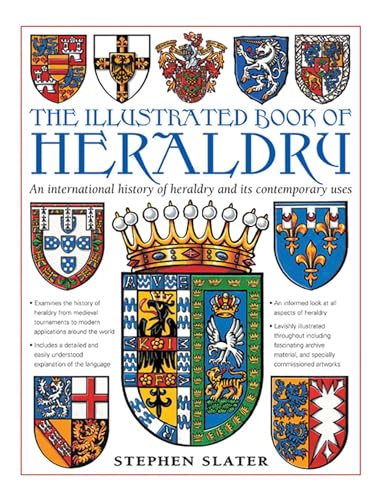
These are affiliate links. If you buy through them, I get a small cut at no extra cost to you.